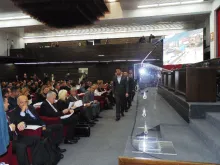
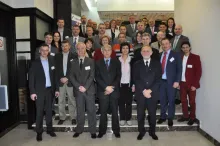
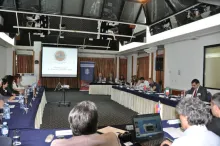
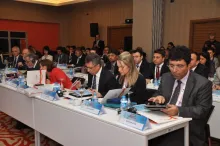
 The Second European Conference on Earthquake Engineering and Seismology (2ECEES) was organized in Istanbul, Turkey, 25-29 August, 2014 as a joint event of European Association of Earthquake Engineering (EAEE) and European Seismological Commission (ESC). With support from Turkish Prime Ministry Disaster and Emergency Managment Agency (AFAD), the conference has also been included in the DPPI SEE Disaster Management Training Programme for the year 2014.

The purpose of the conference was to provide a platform for introducing and discussing Earthquake Engineering and Seismology along with priority issues of global importance. The conference was primarily aimed at civil engineers, geological and geophysics engineers.More than 1,200 people attended the conference. On the margines of the conference programme, a side meeting was organised by AFAD for representatives of 9 DPPI SEE member countries for purpose of strenghtening the collaboration related to seismic networks and relevant data sharing.
The following is the list of topics of the Second European Conference on Earthquake Engineering and Seismology (2ECEES):
- Seismicity of the European-Mediterranean Area
- Earthquake Source Physics
- Earthquake Forecasting and Prediction
- Engineering Seismology and Seismic Hazard Assessment
- Acquisition and Analysis of Strong Motion Data
- Microzonation and Site Effects
- Geotechnical Earthquake Engineering
- Earthquake Scenarios, Vulnerability and Loss Assessment Studies
- Seismic Design Code Developments and Related Issues
- Performance-Based Seismic Assessment and Design
- Seismic Analysis and/or Testing of Structural Elements and/or Systems
- Seismic Analysis and Design of Tall Buildings
- Seismic Analysis and Design of Bridges
- Seismic Analysis and Design of Underground Structures
- Seismic Analysis and Design of Marine Structures
- Seismic Analysis and Design of Foundation Systems / Soil-Structure Interaction
- Seismic Analysis and Design of Transportation and Lifeline Systems
- Seismic Analysis and Design of Active and Passive Structural Control Systems
- Seismic Performance of Historical Monuments and Structures
- Earthquake Risk Mitigation Policies and Methodologies
- Lessons from Recent Earthquakes














 there were 4.309 disasters recorded, resulting from natural hazards around the world where 1.124.854 people perished and a minimum of 1.313 billion USD was recorded in losses. In the year 2011 alone, 365 disasters claimed 33.760 lives; affected 206 million people and inflicted damages worth an estimated 366 billion USD.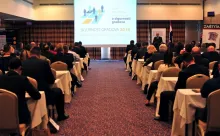
 Meridien Lav Hotel in Split, Croatia, from 19 to 21 March 2014. The conference was organized by Security (Zaštita) Magazine (Tectus Ltd. Company) and the Croatian Network of Urban Security Stakeholders (CNUSS) under the auspices of the Ministry of Interior of the Republic of Croatia and the City of Split in cooperation with the Croatian Security Association, National Protection and Rescue Directorate (DUZS) and Association of Cities.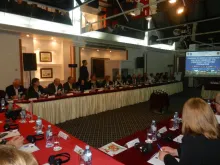
 2014 and was hosted by the Sector for Emergency Management of the Ministry of Interior of the Republic of Serbia.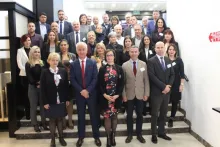


 During 05-06.03.2019 DPPI SEE Secretariat hosted the first event from the annual Disaster Management Training Program in Sarajevo, Bosnia and Herzegovina. Together with UNISDR Europe office, training workshop has been conducted on Sendai Framework Monitoring process. Total number of 17 participants from all DPPI SEE member states had the opportunity to learn about the recent developments related with Sendai Framework Monitoring process, to exchange on their national experiences and to practice some of the online training tools available for Sendai Framework Monitoring. Detailed report on the workshop together with all the presentations from the training workshop will be uploaded on our web page in the following days. DPPI SEE Secretariat express its gratitude to the Ministry of Security of Bosnia and Herzegovina - Sector for rescue and protection for their support in organizing this event.
 DPPI SEE and IPA DRAM partner countries came to Ljubljana this week to discuss the possibility for sustainability of results upon the end of IPA DRAM in November 2019. IPA DRAM has identified five main areas in which the programme results can be sustained and at the same time contribute to the strengthening of DPPI SEE. Those five areas are:
 For the purpose of this workshop the organizational comparative advantage methodology was used. This methodology facilitates the process of performing systematic analysis of internal and external factors that affect an organizations ability to take new task,projects or objectives as well as identifying the resources that would be required should the
  By working in 3 groups participants of the workshop have analyzed all of the 5 recommended IPA DRAM results. The report which will be the outcome from the workshop will include the findings of the analysis and will draft recommendations to be taken under consideration during the upcoming 38.DPPI SEE Regional Meeting in Tirana (16-17.04.2019).
 The event was part of this year Republic of Macedonia contribution to the Disaster Management Training Programme of DPPI SEE and was organized by the Protection and Rescue Directorate of the Republic North Macedonia and the Private Medical Centre Adzi Badem Sistina in Skopje.
 The objective of the event was to share knowledge among DPPI SEE member states about hospital emergency preparedness in cases of earthquakes and promote public private partnerships in the area of disaster risk management. DPPI SEE members states had the opportunity to observe one day practical exercise for patient evacuation after an earthquake at the Private Medical Centre Adzi Badem Sistina in Skopje.
 Based on the invitation from the General Inspectorate for Emergency Situations (GIES) to the Member States of Disaster Pareparedness and Prevention Initiative for South Eastern Europe (DPPI SEE), representatives of DPPI SEE together with a delegation of GIES attended the International Conference on Environmental Legislation, Safety Engineering and Disaster Management - ELSEDIMA, in Cluj Napoca, 17-18 May 2018.
 This activity represented Romania's contribution to 2018 Disaster Management Training Program under DPPI SEE, attended by 11 representatives from Albania, Bosnia Herzegovina, Bulgaria, Macedonia, Montenegro, Romania and Head of the DPPI SEE Secretariat .
 GIES leadership has been represented by First Deputy General Inspector - Colonel Daniel Marian DRAGNE and Lieutenant Colonel Rareş PETRE, European Affairs, Assistance and International Relations Service, responsible officer for DPPI SEE cooperation.